

Understanding the FCA’s FRAME proposals: what the new reporting framework means for UK segregated portfolio managers and advisers
When the FCA published Consultation Paper (CP26/26) introducing the proposed Fund Reporting for Asset Management Entities (FRAME) reporting framework, much of the industry’s attention focused on the proposed replacement of UK Annex IV reporting for AIFMs.
However, the consultation is much broader than Annex IV reporting. It proposes a new supervisory reporting framework designed to provide the FCA with more consistent and comprehensive information across the UK asset management sector.
One proposal that has received comparatively little attention is the introduction of reporting for segregated portfolio managers and advisers (SPMAs).
Unlike the proposed fund reporting requirements, which collect information about investment funds and their operators, the proposed SPMAs return is designed to provide the FCA with greater visibility over the investment management and investment advisory activities undertaken by UK firms, including where those firms manage assets or provide investment advice on behalf of UK and overseas fund managers under delegation arrangements.
A new supervisory reporting objective
Many firms that may fall within the proposed scope already submit regulatory returns to the FCA that are relevant to their permissions and business model. These include FSA038 and MIFIDPRU returns.
The proposed SPMA return does not replace those existing reporting obligations. Instead, it introduces a new supervisory reporting requirement focused specifically on delegated portfolio management and investment advisory activities.
The proposal reflects the FCA’s objective of obtaining more consistent and comparable information about an important part of the UK asset management industry that has historically sat outside its existing supervisory reporting framework.
Who is likely to be affected?
The proposed SPMA return is expected to apply to firms that fall within the FCA’s proposed definition of a ‘segregated portfolio manager or adviser’. This is expected to include certain FCA-authorised investment firms undertaking investment management or investment advisory activities for the wider funds industry, particularly where they act on behalf of UK or overseas fund managers under delegation arrangements.
This may include firms that:
- Act as delegated or sub-investment managers for UK or overseas AIFMs;
- Manage portfolios under delegation from UK or overseas AIFMs or UCITS management companies;
- Provide investment advisory services under a delegation arrangement to UK or overseas AIFMs or UCITS management companies;
- Provide investment management or investment advisory services to fund managers; or
- Operate as collective portfolio management investment (‘CPMI’) firms where their activities fall within the proposed scope.
For these firms, the proposal is not about introducing FCA reporting for the first time. Rather, it introduces a new supervisory reporting requirement designed to give the FCA greater visibility over delegated investment management and investment advisory activities.
Why is this particularly relevant for delegated managers?
Delegation is a well-established feature of the UK asset management industry.
A common operating model involves a third-country AIFM appointing an FCA-authorised UK investment manager under a delegation agreement.
For example, a Guernsey AIFM may appoint a UK investment manager to manage the portfolio of a private equity, real estate or infrastructure fund marketed into the UK under the National Private Placement Regime (NPPR). While the Guernsey AIFM remains responsible for meeting its UK fund reporting obligations, the UK investment manager is responsible for making the day-to-day investment decisions under the delegated mandate.
The FCA considers delegated portfolio management to be an important part of the UK asset management industry. Through the proposed SPMA return, it is seeking greater visibility over the investment management and investment advisory activities undertaken by UK firms, including where those activities are performed on behalf of UK and overseas fund managers. Unlike the proposed FRAME reporting return, the SPMA return is focused on the activities of the UK investment manager or adviser, rather than the underlying investment fund.
What information is proposed?
The consultation proposes collecting information including:
- Assets managed under discretionary mandates;
- Assets advised under advisory mandates;
- Client categories, including UK and overseas AIFMs, UCITS management companies, insurers and pension schemes;
- Gross notional derivative exposure;
- Long and short market values; and
- Assets managed on behalf of overseas funds that are not marketed into the UK.
For many firms, this information already exists within portfolio management, operations and client reporting systems. The challenge will be ensuring that it can be governed, validated and reported consistently.
Review the proposed reporting templates and engage with the FCA
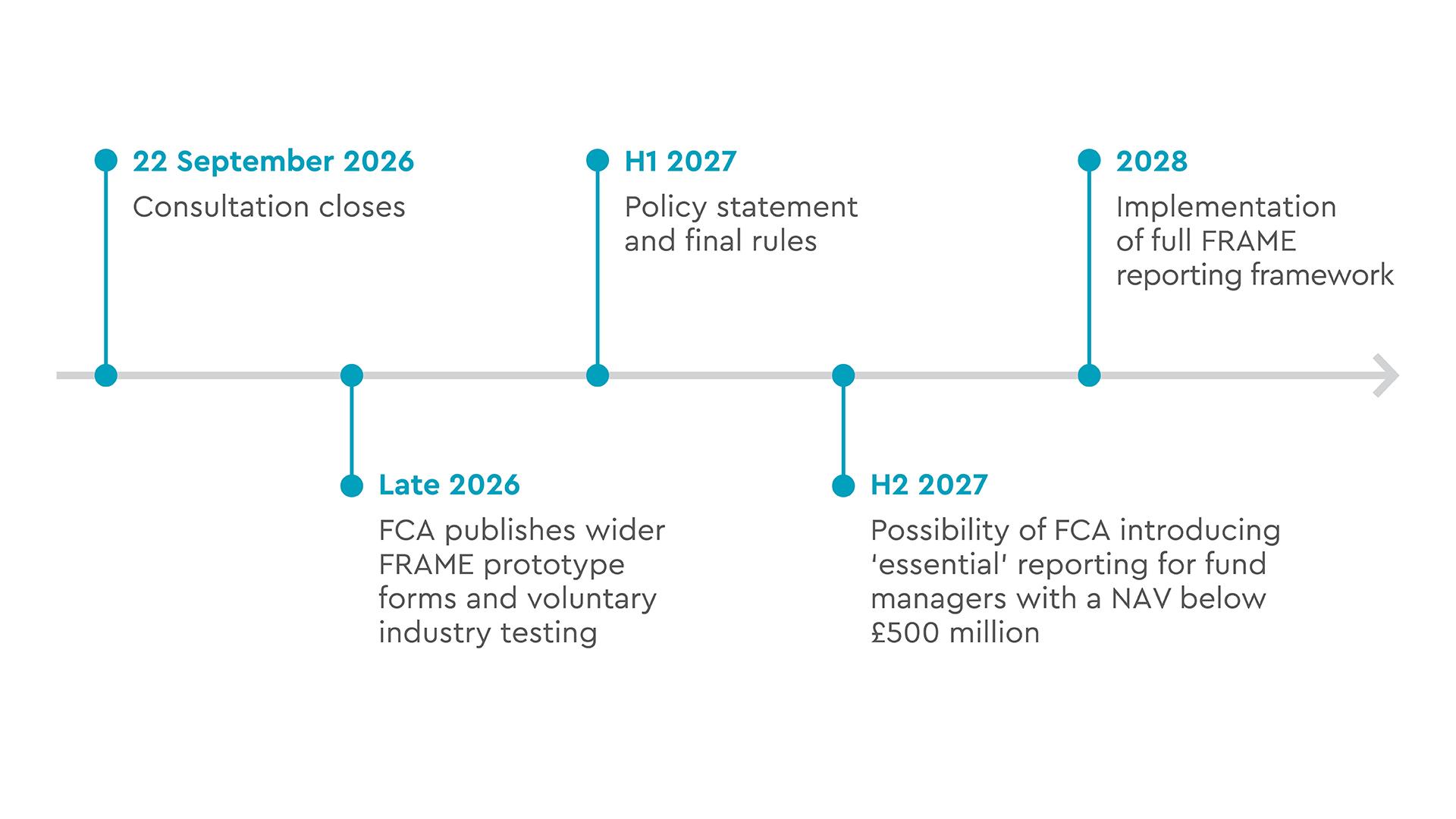
As part of CP26/26, the FCA has published three draft reporting templates together with an online form version of the proposed ‘essential’ reporting requirements that firms can test on a voluntary basis. In addition, the FCA has confirmed that before the end of 2026, it will produce a wider FRAME prototype form for firms to test on a voluntary basis. This provides firms with an opportunity to:
- Assess data availability;
- Identify reporting gaps;
- Test governance and reporting processes;
- Evaluate system readiness; and
- Provide practical feedback before the reporting framework is finalised in the first half of 2027.
Early engagement should help firms understand the proposed requirements and reduce implementation challenges should the proposals be adopted.
Implementation timeline
Image
What should firms be doing now?
Although the consultation remains open, firms that may fall within the proposed scope should begin preparing now.
Practical steps include:
- Determine whether your firm falls within the proposed scope by reviewing your permissions, business model and delegation arrangements.
- Review the draft SPMA reporting template to understand the proposed data requirements and identify any information that is not currently captured.
- Assess your systems, governance and reporting processes to determine whether they can support the proposed reporting requirements if implemented.
- Participate in the FCA’s prototype testing and consider responding to the consultation, particularly if the proposals would have a significant operational impact on your business.
How Ocorian can help
Preparing for new regulatory reporting requirements involves more than understanding the rules. Firms must also assess the operational impact, identify data gaps and establish robust reporting processes.
Ocorian works with asset managers, investment managers and advisers across the UK, Europe and other jurisdictions, supporting firms with regulatory reporting and implementation projects. Our specialists have extensive experience advising UK and third-country AIFMs, delegated investment managers and authorised fund managers on regulatory reporting obligations, including Annex IV, UK regulatory reporting and emerging FCA reporting requirements.
As the FRAME proposals develop, we can support firms by:
- Assessing whether they are likely to fall within the scope of the proposed reporting framework;
- Reviewing existing governance, systems and reporting processes;
- Performing gap analyses against the proposed reporting templates;
- Advising on the interpretation of the FCA’s proposals and their practical application; and
- Supporting implementation, testing and ongoing reporting once the final rules are introduced.
If you would like to discuss how the proposed FRAME reporting framework may affect your business, or would like assistance assessing your reporting obligations, please get in touch with Ocorian’s regulatory consultants via Ocorian’s website.
Related Items
View all

