

Preparing for the UK’s new fund reporting framework
Why the FCA’s proposed FRAME regime could reshape regulatory reporting and why UK, EU and third-country AIFMs should start preparing now.
This article forms part of a series examining the FCA’s proposed reforms to the UK’s asset management framework. Following our overview of the consultation package, each article explores the key proposals set out in each consultation paper within the consultation package, helping firms understand the proposed changes, assess their potential impact and identify practical steps to consider.
Background
CP26/26 sets out the FCA’s proposed Fund Reporting for Asset Management Entities (‘FRAME’). It represents a significant redesign of the FCA’s approach to fund reporting, introducing a broader, more standardised framework that extends beyond Annex IV and existing UK UCITS reporting. FRAME will create a more consistent reporting architecture across a wider range of authorised and unauthorised funds.
Four things firms should know about FRAME
- FRAME is broader than both Annex IV and existing UK UCITS reporting.
- Third-country AIFMs marketing AIFs in the UK under the NPPR are expressly within scope of the proposed reporting framework.
- The FCA intends to publish prototype reporting forms and undertake voluntary industry testing before implementation.
- The UK is replacing its existing Annex IV reporting framework, while the EU is retaining and enhancing Annex IV reporting under AIFMD II.
For AIFMs working on a cross-border basis (i.e. AIFMs marketing AIFs in both the UK and EU), the greatest challenge may be managing two increasingly distinct reporting frameworks rather than simply producing a new regulatory return.
Why is the FCA introducing FRAME?
The FCA has been clear that the current reporting framework has evolved over time through multiple reporting regimes designed for different types of firms and funds.
The FCA believes this has resulted in:
- Duplicated reporting requirements;
- Inconsistent data across fund sectors;
- Gaps in supervisory information;
- Reporting that is not always proportionate to the risks presented by different funds; and
- Challenges in comparing information across the asset management sector.
FRAME is intended to address these issues by creating a more coherent and consistent reporting framework capable of supporting more effective supervision.
FRAME is bigger than Annex IV
As stated above, FRAME is much more than an update to the UK’s existing Annex IV or UK UCITS reporting regime. It represents a broader and more fundamental redesign of UK fund reporting to create a more consistent reporting architecture across a wider range of authorised and unauthorised funds.
Rather than introducing one standard return for every fund, the FCA proposes a common reporting framework with reporting requirements tailored to different fund types, characteristics and risks. In this regard, although many existing Annex IV and UK UCITS reporting data items are likely to remain relevant, firms should not assume that their current reporting returns will simply be replicated under FRAME. The proposed framework is built around a modular reporting architecture, meaning existing data may be reorganised, supplemented or collected differently depending on the type of fund, its characteristics, activities and risks.
In other words, FRAME is best viewed as a new reporting architecture rather than a new reporting template.
The publication of the prototype forms will provide firms with the first practical indication of how the FCA expects reporting to operate under FRAME. For many firms, this is likely to be the point at which the operational implications become clearer rather than the policy proposals themselves.
Which firms and other market participants are likely to be affected?
Although the detailed reporting requirements will vary, the proposals are expected to affect a broad range of firms across the asset management sector, either through direct reporting obligations or indirectly through their operational oversight or reporting responsibilities.
Firms expected to have direct reporting obligations:
- UK AIFMs;
- Third-country AIFMs (including EU AIFMs) marketing AIFs in the UK under the National Private Placement Regime (‘NPPR’);
- UK UCITS management companies;
- Operators of Non-UCITS Retail Schemes (‘NURS’); and
- Other authorised collective investment schemes.
Other firms that may be operationally affected:
Fund administrators;
Depositaries;
Delegated investment managers;
Regulatory reporting providers; and
Technology and data providers.
These firms may not be directly subject to reporting obligations under FRAME but are likely to be affected where they support, oversee or facilitate regulatory reporting, data management, governance or operational processes.
The growing UK and EU reporting divergence
Perhaps the most significant implication of the FCA’s proposals is not FRAME itself. It is the growing divergence between the UK’s and the EU’s reporting frameworks.
The UK has chosen not to implement AIFMD II. Instead, it is developing a domestic reporting framework through FRAME.
Meanwhile, the EU is enhancing Annex IV reporting under AIFMD II. While the reporting will continue to be known as Annex IV reporting, ESMA is developing new technical standards, reporting templates, data fields and reporting instructions to support the revised regime.
For firms operating solely in the UK, FRAME will represent a significant reporting transformation. For AIFMs marketing AIFs in both the UK and EU, the implications are likely to be much more impactful and broader.
A changing reporting timeline
For many cross-border AIFMs, the reporting journey is expected to develop in phases. Although the final UK and EU reporting requirements are still developing, firms marketing AIFs in both jurisdictions may increasingly need to operate distinct reporting methodologies, data models, governance arrangements and reporting processes to comply with two evolving regulatory reporting frameworks.
Image
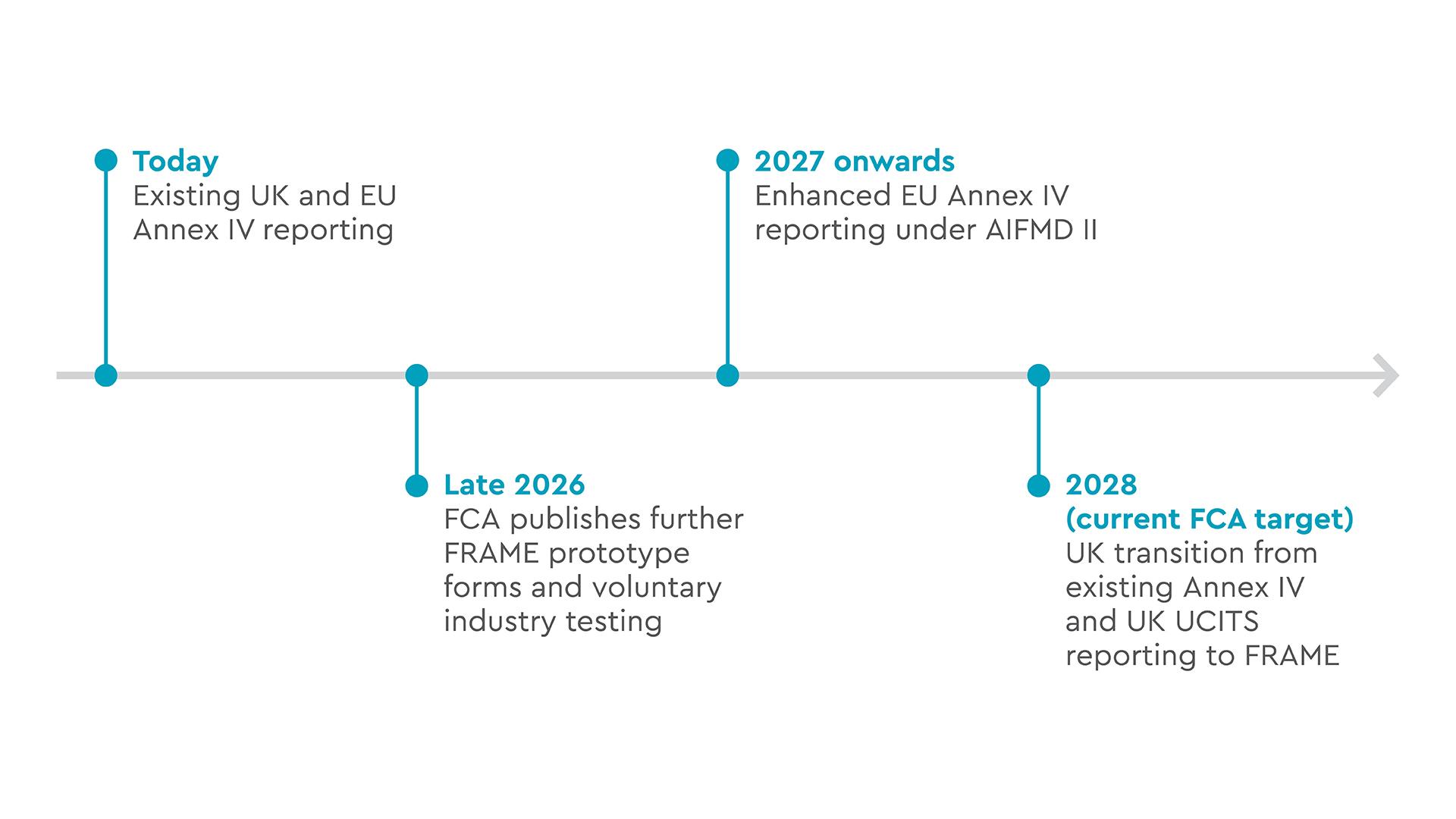
This means many firms may first need to update their EU Annex IV reporting processes, while continuing to submit the existing UK Annex IV reports. They may then need to undertake a second reporting implementation programme as the UK transitions to FRAME.
Although firms may continue to use the same reporting platform, many are likely to require increasingly distinct:
- Reporting methodologies;
- Reporting templates;
- Data models;
- Calculation methodologies;
- Validation rules;
- Governance arrangements; and
- Operating processes.
What this means for firms
For many firms, the greatest implementation challenge is unlikely to be completing a new reporting return.
The more significant question is whether existing reporting operating models will remain fit for purpose as the UK and the EU’s reporting frameworks continue to diverge.
Cross-border AIFMs are likely to be among the firms most affected. Rather than managing one largely aligned Annex IV reporting process, they may ultimately need to support two increasingly distinct regulatory reporting frameworks, implemented over different timelines and based on different reporting methodologies. The concern for cross-border AIFMs is whether existing reporting operating models, governance arrangements, data architecture and technology remain capable of supporting two evolving reporting frameworks.
Increasingly, regulatory reporting is becoming as much a data governance and operating model exercise as a compliance obligation.
Unlike many regulatory reforms, firms will have an opportunity to gain early insight into how the proposed reporting framework may operate in practice. The FCA intends to publish further prototype reporting forms before the end of 2026 and has invited firms to participate in voluntary industry testing as the framework develops.
The FCA has not yet confirmed the final technical submission arrangements for FRAME. However, firms should expect further detail as the prototype forms and industry testing progress. Alongside the proposed reporting changes, firms may also need to consider the implications for reporting technology, data architecture and third-party reporting solutions.
How Ocorian can help
Ocorian supports UK and international firms throughout the regulatory reporting lifecycle, including:
- FRAME impact and readiness assessments;
- UK and EU reporting operating model reviews;
- Annex IV health checks and independent quality assurance;
- Regulatory reporting production and ongoing support;
- UK NPPR reporting and compliance support; and
- Strategic implementation planning and regulatory change advisory services.
Whether you currently prepare Annex IV reports in-house or use a third-party reporting provider, understanding how FRAME and AIFMD II could affect your reporting operating model is likely to become increasingly important over the coming months.
If you would like to discuss how the proposals may affect your business, please contact our regulatory consultants.
About the authors
Abi Reilly is a Partner at Ocorian. She advises a broad range of regulated firms, including asset managers on regulatory compliance and governance. With over 20 years holding senior in-house risk and compliance roles and 40 years in financial services, Abi has significant experience in helping firms navigate complex regulatory requirements with practical commercial advice.
Kaniz Gatt is a Principal Consultant in Ocorian’s Regulatory and Compliance team. She advises UK and Third Country AIFMs on AIFMD compliance, Annex IV reporting and National Private Placement Regime (‘NPPR’) requirements. Her experience includes supporting firms with regulatory reporting obligations across multiple jurisdictions, helping clients interpret complex reporting requirements, implement practical compliance solutions and navigate the evolving regulatory landscape.
Related Items
View all

