

Conflicts of interest: is your framework keeping up?
Three themes from the FCA's multi-firm review
If we were to ask most firms whether they understand conflicts of interest, the answer would be a resounding yes. In many cases, the foundations are in place: a conflicts policy, a register, personal account dealing requirements, gifts and entertainment processes and training.
The reality is that those foundations are insufficient to deal with the complexity of conflicts most firms need to contend with.
The FCA’s multi-firm review, Conflicts of interest and fair customer treatment in private markets, highlights this and the FCA now requires firms to look beyond basic foundations to manage conflicts effectively.
Reading the FCA’s findings, three themes stand out for us:
A conflicts framework that evolves with the business, rather than one written once and filed.
Oversight of personal interests based on risk, not just rules and thresholds.
Conflicts built into investment decisions, rather than treated mainly as a compliance process.
Does your conflicts of interest framework still fit the business you run today?
Your conflicts framework should evolve with your business
Many firms look quite different from how they did a few years ago. Common changes include:
Launching new products or services or taking on new regulated activities.
Growing rapidly or moving into new markets and customer segments.
Acquiring businesses, changing ownership, or entering joint ventures.
Changing who makes key decisions, with new board members, senior managers, or overlapping roles.
Outsourcing more activities or increasing reliance on group companies and connected providers.
Each of these is a commercial decision, but each one also changes the firm's conflicts profile. This is very much aligned with one of the FCA's key findings. In some firms, more complex business models, and therefore more inherent conflict risk, did not lead to proportionately stronger governance and controls.
The policy stayed the same. The business underneath it did not.
The FCA's starting point is the business model. A firm's ownership, products and services, customer base, commercial relationships, and revenue model all shape where conflicts arise and how significant they could be.
The framework should reflect how the firm operates, not just its legal structure.
In practice, this means:
Identifying conflicts is an ongoing exercise, not a once-a-year activity.
Actual, potential, and perceived conflicts can be identified promptly.
A change in ownership, group structure, products, strategies, or operating model triggers a fresh look, rather than waiting for the next policy review.
Governance must evolve too
It is not only the conflicts register that needs to keep up. So does the governance around it.
Image
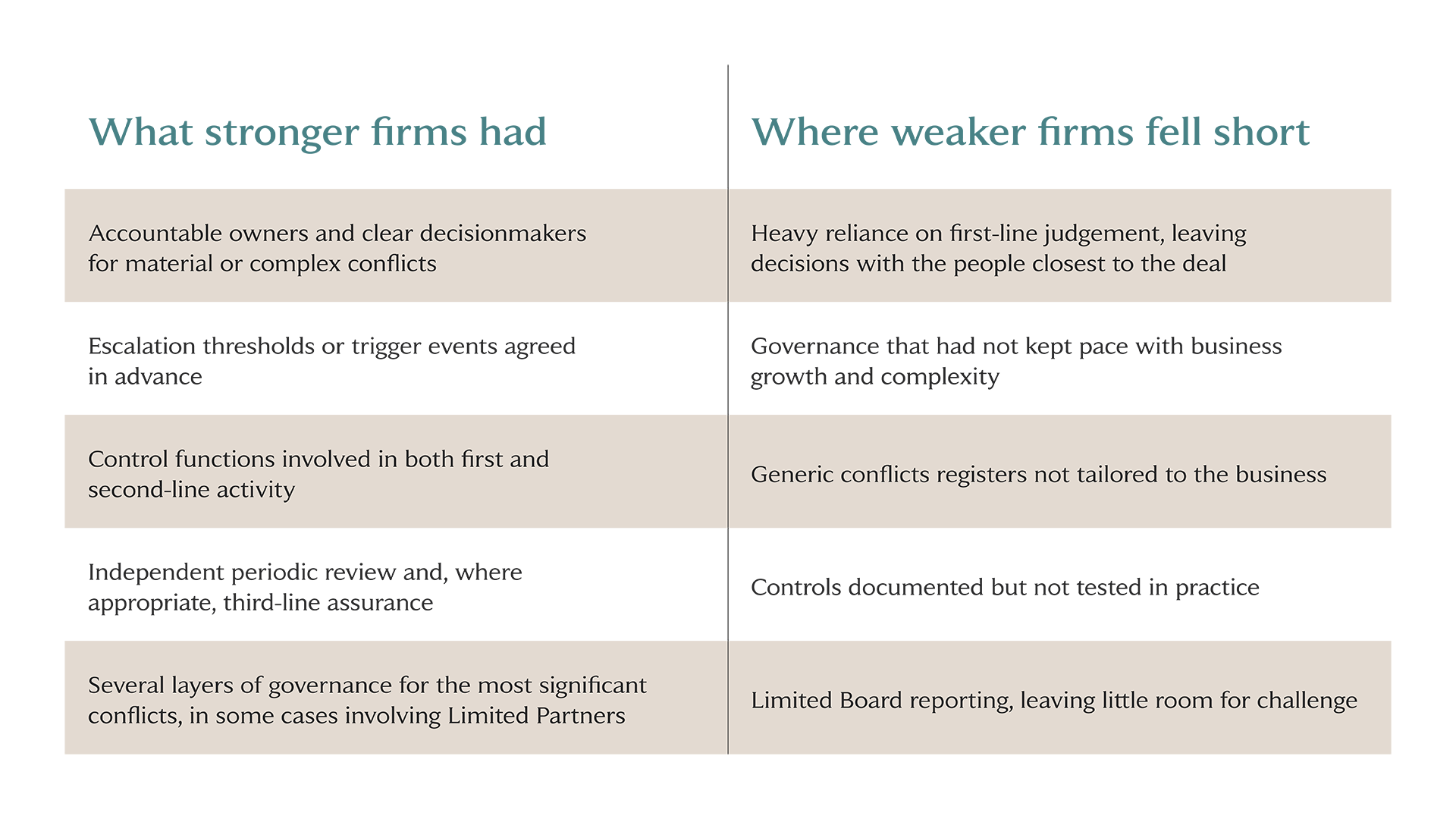
The people closest to the deal are often best placed to spot a conflict, but not always best placed to judge whether the outcome is fair and provide effective and meaningful challenge. That is why an independent review matters.
That does not mean every firm needs the same level of governance. A small firm with a simple business model will not need the arrangements of a large, multi-business group. But a firm that has added products, services, clients, or legal entities cannot keep relying on a framework built for a much simpler business.
Evolution in products and structures should trigger a review of governance. A gap may exist which can create issues downstream.
Personal conflicts: from rules to risk
Personal conflicts are the part of the framework most people know best. The familiar controls include:
PA dealing pre-clearance
Gifts and entertainment clearance and registers
Annual declarations
Training and attestations
They are all useful controls. The trouble is they can easily become box-ticking: was the form filled in, was it under the limit, was it approved? The FCA's review highlights the need for firms to develop beyond that in two distinct ways.
1. A broader view of personal investments
Firms need to look beyond conventional listed-security dealing.
The real question is whether an employee's financial interests could compete with those of clients, including a fund or its investors, wherever those interests sit.
2. Gifts and entertainment under the spotlight
A recurring area of weakness. Weaker firms relied mainly on policy thresholds and generic approvals, with little evidence they were finding the conflict or inducement risk.
Stronger firms had clear standards, active compliance oversight, robust records, and monitoring of patterns over time.
Approving a gift is not the same as overseeing the risk behind it.
A threshold tells you whether something needs sign-off, but it does not tell you whether it matters.
A single dinner may be perfectly fine. The same counterparty hosting the same deal team three times in the run-up to a key decision is a different conversation, and you would only spot it if someone were looking at the records together, rather than one approval at a time.
So, consider this.
The usual question: "Is this below the limit?"
The better questions: "Could this influence, or reasonably appear to influence, a decision? Is this a repeatable event? Is it reasonable to expect the gift/entertainment?"
What risk-based oversight looks like:
Personal interests are captured broadly, not just listed securities.
PA dealing, gifts and entertainment and outside interests are looked at together and linked to the wider conflicts’ framework.
Compliance looks for trends by counterparty, by individual and by timing around investment decisions.
Approvals take account of context, not just value.
Records are good enough to show what was reviewed and why.
This is not about adding more paperwork. It means putting the effort where personal interests could get in the way of treating investors fairly.
Conflicts in the investment process
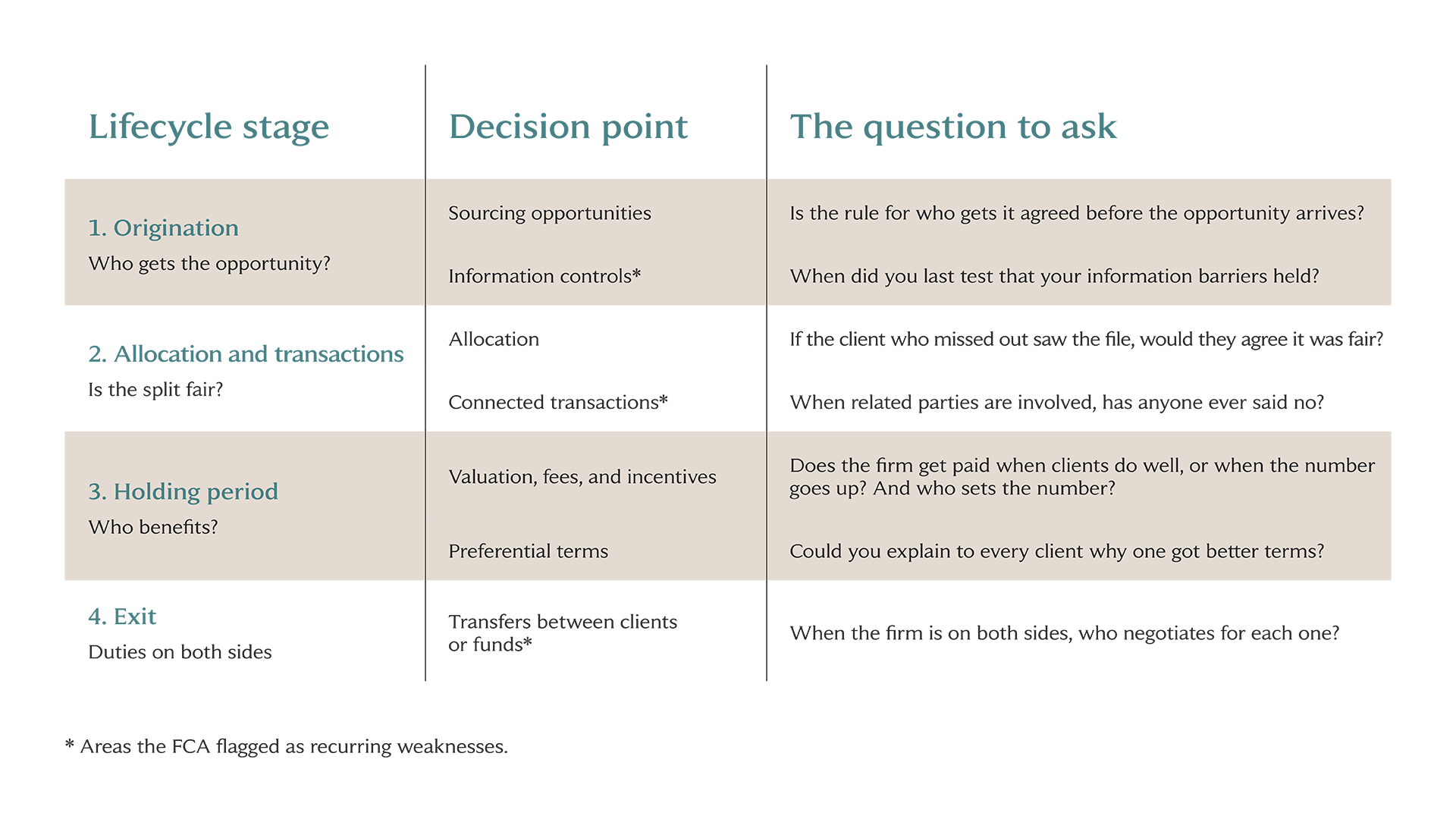
This is where conflicts become far more complex. Personal conflicts tend to involve one person and one decision. In the investment process, the interests of the firm, its people and different clients can compete, often at the same time. For firms that make investment decisions for clients, this is the most important part of the review. Conflicts exist through the whole investment lifecycle, from origination and allocation through to transactions, valuation, and exit. The strongest firms had built conflict controls into the investment process itself, rather than relying on a central policy or a compliance review after the event.
Conflicts management must be an investment process, not just a compliance one.
Where interests start to pull apart
Image
Disclosure is not management
Disclosure still matters, but FCA rules treat it as a last resort. It should sit at the end of the process, not replace it:
Image
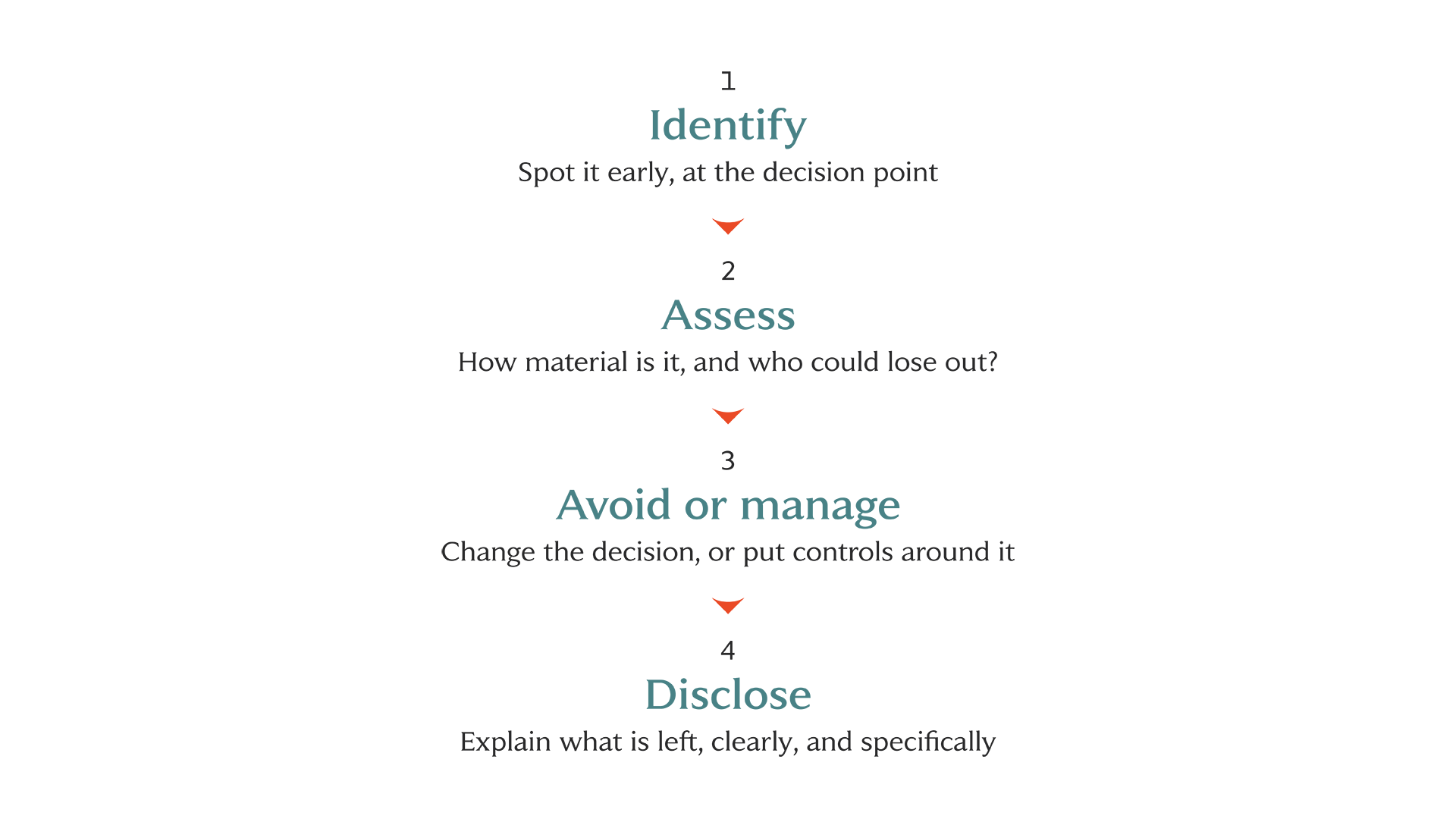
Telling investors or clients about a conflict does not mean you have managed it.
Can you show your working?
The practical test is simple. Pick a recent allocation decision, cross-fund transfer, or continuation transaction. Could someone who was not in the room follow:
Who identified the conflict?
Who challenged it?
Why was the outcome fair?
If the file stops at 'Compliance was consulted' or 'investors were informed', there is still work to do.
What should firms be doing now?
The FCA expects firms to consider the findings and identify gaps in their own arrangements, and further supervisory follow-up is likely. We would keep that exercise practical:
1. Map business change against the framework
List what has changed in recent years (funds, strategies, structures, ownership) and check that the conflicts inventory and governance changed with it.
2. Agree on your triggers
Decide which events prompt a conflicts review, rather than waiting for the annual policy refresh.
3. Be clear on ownership and escalation
Know who owns material conflicts, what goes to which forum and where the independent challenge comes from.
4. Join up personal conflicts
Look at PA dealings, gifts and outside interests together, and monitor for patterns.
5. Map the decision points
Walk through the investment lifecycle and show where conflicts are considered at each stage.
6. Evaluate the evidence
Sample a few recent decisions and see whether the file tells the story. Check that your systems and training support good records.
The bottom line
Conflicts are part of every regulated business, and growth, new products and more complex structures will only add to them. The review may have focused on private markets, but the message applies to every firm.
The FCA is not asking firms to remove conflicts; it is asking them to keep pace with proper mitigation of them. In practice, this means:
Change triggers a fresh look, so the framework never falls behind the business.
Oversight looks for patterns, not just one-off approvals.
Fair outcomes can be evidenced at every key decision, not just asserted.
How Ocorian can help
Whether you need a quick health check or support, we can help you demonstrate your conflicts framework is keeping up:
Conflicts health check – an independent review of your framework against the FCA's findings and comparable firms, with prioritised, practical actions.
Conflicts register refresh – mapping recent business change so your register reflects how your firm operates, and links to your wider risk framework.
Governance and escalation – clear ownership, agreed triggers and board reporting that supports challenge.
Investment process conflicts – drawing on our specialist experience across investment and fund management, we help map conflicts at each stage of the investment lifecycle, from allocation and connected transactions to valuation, fees, and transfers, and build practical controls and evidence into each decision.
Decision-point testing – walking through key decisions and testing whether the file shows who identified the conflict, who challenged it and why the outcome was fair.
Joined-up personal conflicts oversight – using our compliance portal, The Gateway, to bring PA dealings, gifts and entertainment and attestations together, with reporting that helps spot patterns.
Policies, training, and monitoring – proportionate policies, tailored staff training and conflicts built into your compliance monitoring plan.
Supervisory readiness – mock reviews to evaluate how well your arrangements would stand up to FCA scrutiny.
Need a deeper analysis?
To discuss how the FCA's findings may affect your business, please contact Ocorian’s Regulatory Consultants via Ocorian’s website.
Related Items
View all

