

Asian private market fund managers control $3.51 trillion in AUM, says new study
Ocorian’s Global Asset Monitor reveals that Asian domiciled funds account for a fifth of global private market assets
New analysis from Ocorian*, a market leader in asset servicing for private markets and corporate and fiduciary administration, reveals that Asian based private market funds currently hold around $3.51 trillion in assets under management.
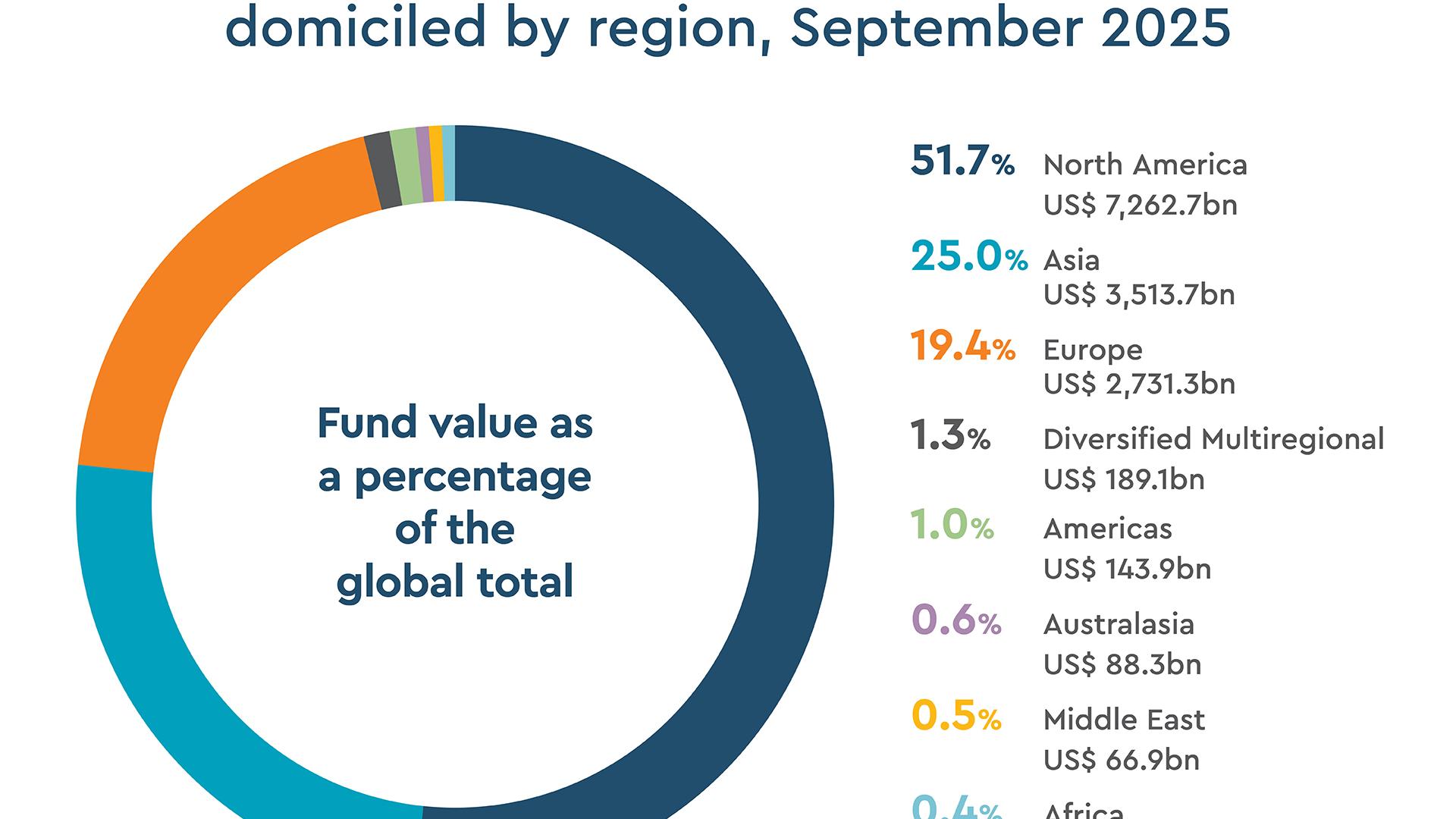
Around a quarter (25%) of global assets in private market funds are in Asian-domiciled funds, Ocorian’s Global Asset Monitor found.
Ocorian’s new analysis breaks down how Asian domiciled private markets funds are split by type. Out of the $3.51 trillion total, private equity funds dominate, accounting for 86% of the total at $3.04 trillion in assets followed by infrastructure at $222 billion (6%), real estate at $188 billion (5%) and private credit at $65 billion (2%).
Image
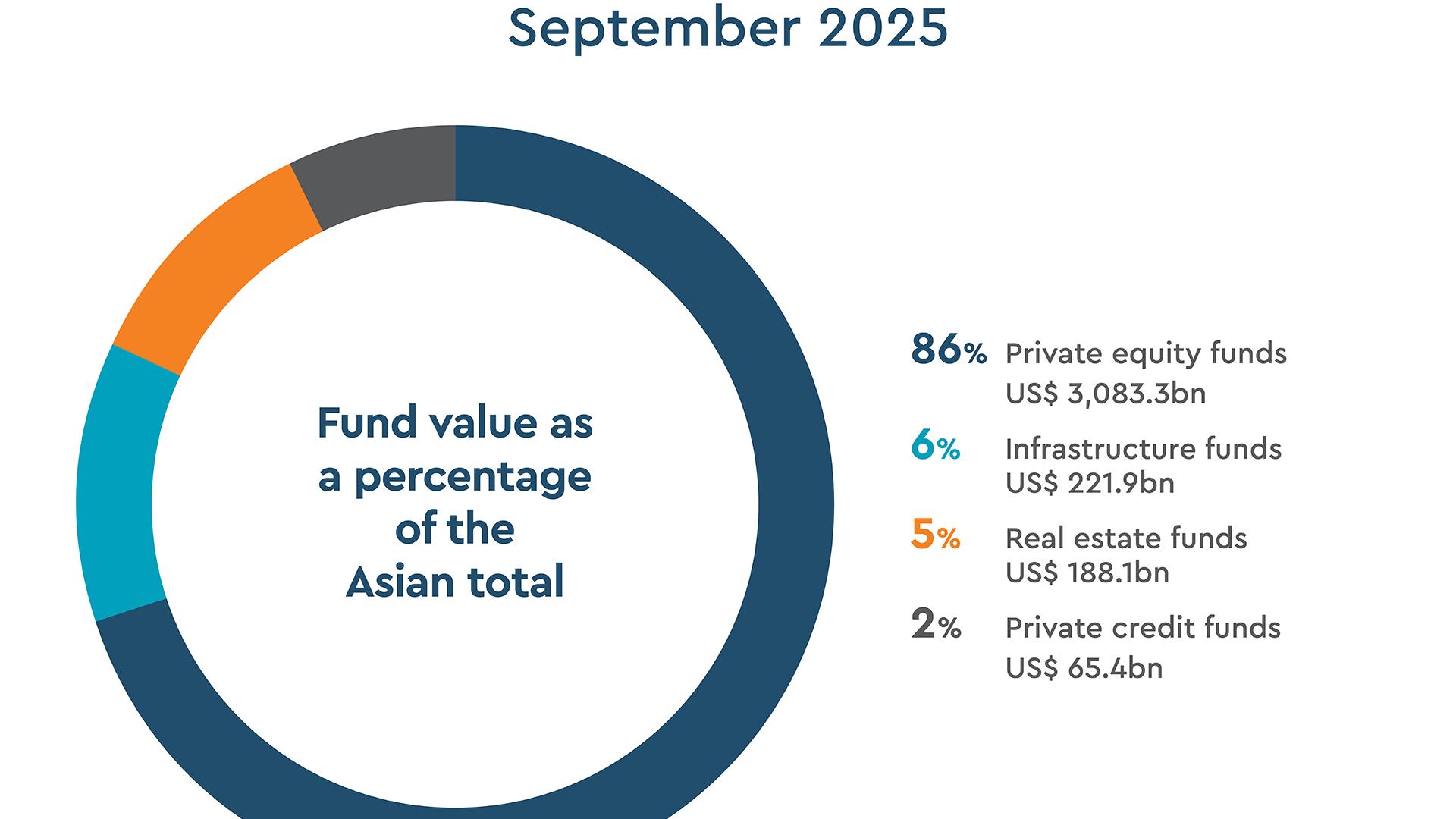
Private equity assets in Asia accounted for around 30% of global growth this year despite making up just a fifth of underlying portfolio assets. Asia’s private equity assets are up 15.8% this year, the analysis shows.
More than half (52%) of global assets in private market funds are in US-domiciled funds, Ocorian’s Global Asset Monitor shows. This compares to a quarter (25%) in Asia and around a fifth (19%) in Europe.
Private market assets under management domiciled by region, September 2025
Image
Robin Harris, Head of APAC at Ocorian said: “Private equity dominates in Asian private markets assets under management and that is reflected by** the fact that just 14% of Asian companies with over $100 million in revenue are publicly listed.
“This makes private markets in general crucial for accessing the growth in Asia with other private market sectors also ripe for expansion.
“At Ocorian, we help alternative asset managers handle operational and regulatory complexity across the full investment lifecycle, especially when operating scale is a differentiator and investor needs and profiles are evolving fast across asset classes."
** Asia's Private Markets: Growth, Innovation, Value | Hamilton Lane
About Ocorian
Ocorian is a global leader in fund services, corporate and trust services, capital markets, and regulatory and compliance support.
Unlocking new value for its clients across jurisdictions and service lines is Ocorian’s priority; it manages over 20,000 structures on behalf of 9,000+ clients including financial institutions, large-scale international organisations, and high-net-worth individuals.
Ocorian provides fully compliant, tailored solutions that are individual to clients’ needs, no matter where in the world they hold financial interests, or however they are structured.
The group offers a full suite of corporate, fund and private client services across a network of offices spanning all the world’s financial hubs. Locations include Bermuda, BVI, Cayman, Denmark, Finland, Germany, Guernsey, Hong Kong, Ireland, Isle of Man, Jersey, Luxembourg, Mauritius, Netherlands, Norway, Singapore, Sweden, UAE, the UK, and the U.S.
To find out more about Ocorian and its services, including regulatory information, visit www.ocorian.com
Methodology
Ocorian commissioned 5iresearch to produce the Global Asset Monitor which considers eight main asset classes that make up the vast bulk of the world’s assets. Four of these are in public markets, namely listed equities and three categories of listed bonds (corporate, sovereign, and other which include municipal and agency bonds). The other four are in private markets, namely private equity, private debt, infrastructure and real estate. We recognise there are other kinds of assets out there in the world, such as residential and commercial property, commodities, art and so on. But we have chosen ours to represent the easily investable universe: investors can buy public assets on exchanges and they can participate in private markets, for example via funds.
Private market data is sourced from Preqin unless otherwise stated, but since this data is only available infrequently and with considerable time lags, we have ‘nowcast’ it by looking at the change in value of relevant public markets since the last Preqin update was released and adjusting the values accordingly. These ‘nowcasts’ are intended only to provide a guide to recent developments.
Public market data is sourced mainly from Factset. Data was captured at market close on September 1st 2025. The equities time series looks at the largest 2,250 companies in the world today and how their market capitalisations have evolved over time. These companies represent 85% of global market capitalisation so we have scaled up by the remaining 15% to show the full global equity market value in each year. To measure the size of the bond markets we have considered both the market value and the face value in each country (and sector in the case of corporate bonds) each year – sourced from Factset. Where data limitations impact the sovereign results, we have derived our figures by using general government debt levels as a proxy for the bond market.
All data is converted to USD at prevailing spot rates. Currency fluctuations may therefore make an impact in the short term, but over the long-term the effect of exchange rates tends to even out almost entirely at the global level. No account has been taken of inflation.
Related Items
View all

