

Chinese and Taiwanese wealth map different paths
As personal wealth increases across the globe it naturally becomes more mobile, but the pathways to reaching the world vary by every UHNWI and family. In Asia, this year Ocorian’s team has been engaging with two different routes from two different departure points: China and Taiwan.
Chinese wealth has grown in line with global trends. The UBS Global Wealth Report 2025 reports that across 2024, in mainland China the millionaire population increased by more than 380 people per day. In Greater China (mainland plus Hong Kong and Taiwan) the change in personal wealth from 2023 to 2024 was 3.42%, greater than the figure for Southeast Asia (2.67%).[1]
As wealth grows, Chinese and Taiwanese UHNWIs and families are mapping different routes to protecting, diversifying and growing their wealth.
China: mobility driven by generational priorities
Among Chinese families, particularly those led by a younger generation of entrepreneurs, wealth planning has moved beyond domestic accumulation. The focus is increasingly on creating flexibility for the next generation and is resulting in significant outflows from China.
Education opportunities overseas, lifestyle balance and the ability to operate internationally now sit at the centre of long-term planning. This is not a retreat from China. It is a recalibration of how wealth supports family life over time.
Historically, protectionist policies from the Chinese government have made it difficult for wealth to be truly mobile. It’s still the case that strict rules necessitate long-term planning, but there is recognition that only by modernising what’s on offer domestically will the Chinese government incentivise keeping money in the country.
Ongoing reforms in China’s trust and wealth management regimes go some way to creating a wealth-friendly environment. Chambers has highlighted modernisation of trust registration, the growth of charitable trusts and stronger regulatory frameworks as some of the steps that have been taken.[2]
Nevertheless, flexibility and diversification remain the aims of many UHNWIs and families, and the traditional regional centres of Singapore and Hong Kong maintain their dominance for structuring.
Singapore is commonly used as a base for long-term governance, valued for its regulatory stability and suitability for sophisticated family office structures. Hong Kong continues to play a critical role as a super-connector to global markets when speed and liquidity are required. Rather than choosing one jurisdiction, many families use both, each serving a distinct purpose within a coordinated framework.
What this reflects is a broader shift. Mobility works only when governance is designed alongside it. Without that alignment, flexibility quickly gives way to fragmentation.
Family offices as the structural response
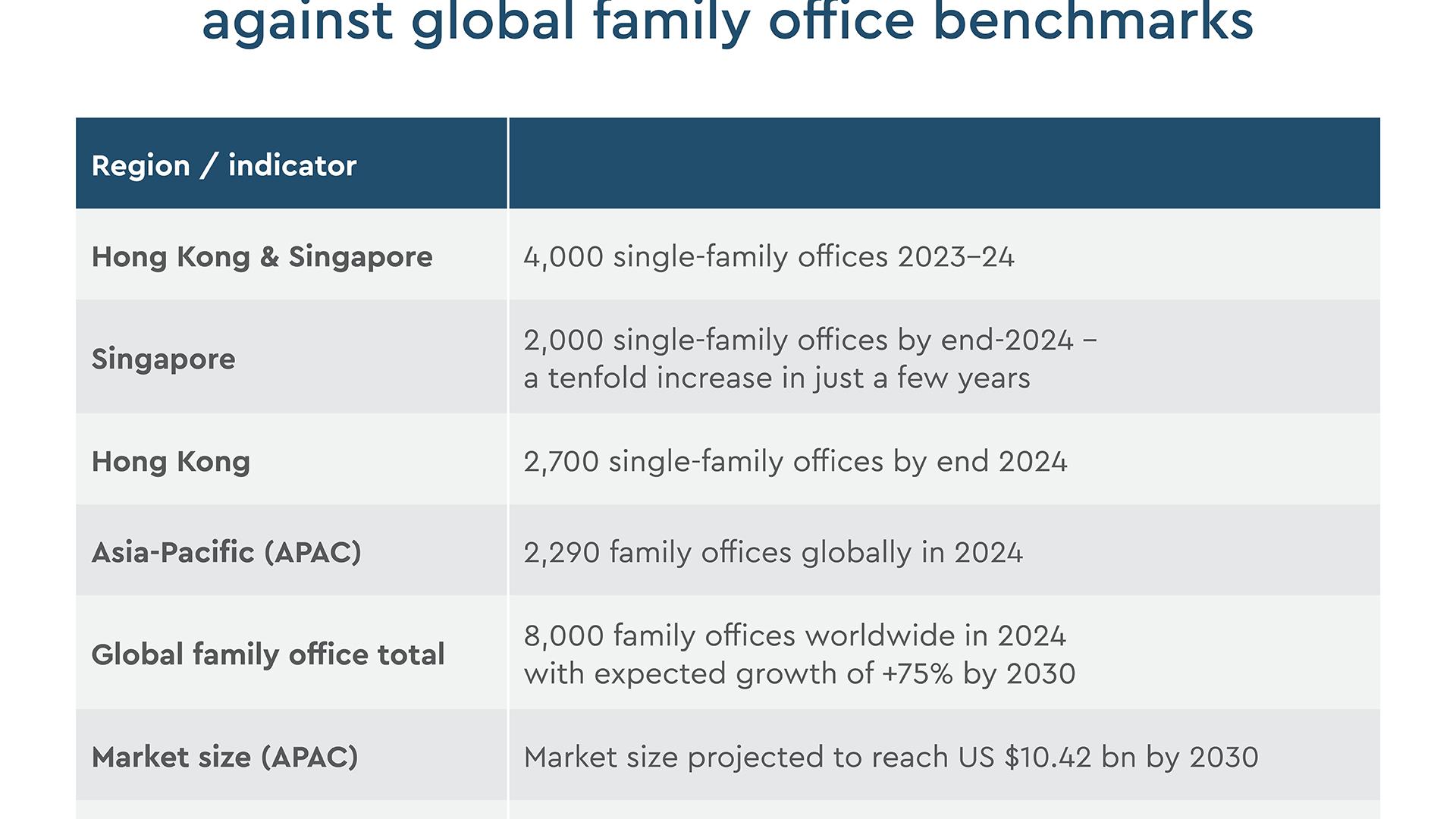
As families become more geographically dispersed, the way their wealth is organised has had to evolve. This has driven strong growth in family office structures across Asia, but their purpose is changing.
Today, a family office is less about scale and more about coordination. Families are managing multiple residences, diversified international portfolios and increasingly complex intergenerational dynamics. Without a central framework, decision-making can become inconsistent, and risk can accumulate unnoticed.
At the same time, families are seeking simplicity in execution. As structures grow more complex, there is less appetite for managing multiple counterparties across jurisdictions. There is growing demand for integrated solutions that provide consistent administration, governance and oversight across borders.
Indeed, we have observed that many Chinese clients especially value the convenience, relationship-building and efficiency of using a single provider for outsourcing their private client services. We work with families to design governance frameworks that allow complexity to exist without undermining control, visibility or long-term continuity.
Taiwan: a distinct westward migration pathway
Taiwanese wealth follows a different but equally instructive pattern. Rather than centring on Asian hubs, many Taiwanese families are looking directly to key OECD investment jurisdictions such as the United States, Canada, Australia and Japan.
These destinations are often chosen for education pathways, lifestyle considerations and long-term business expansion. Establishing a presence in these markets early allows families to plan for future generations while building international commercial exposure over time. There is also a perceived cultural alignment for many younger-generation Taiwanese, whose global outlook is a direct reaction to the regional preferences exhibited by older relatives, and by China.
Compared with Chinese families, Taiwanese wealth tends to rely less on Singapore or Hong Kong as primary structuring hubs. Instead, families often build direct links with target markets. This results in a different geographic footprint, even though the underlying drivers around education, lifestyle and long-term planning are similar.
Taiwan demonstrates that while Asian wealth is globalising, there is no single model. Structures reflect family background, business exposure and long-term intent. What matters is whether those structures can support mobility sustainably.
A new era of global family wealth
Asian private wealth has entered a new phase. It is defined less by domestic accumulation and more by mobility, foresight and disciplined governance. Families are building multi-location lives that require structures capable of operating seamlessly across jurisdictions and generations.
Supporting this shift requires more than technical expertise. It requires a practical understanding of how global families operate and how wealth must be administered in reality.
At Ocorian, we work with families to design and manage international structures that reflect these evolving needs. As the architecture of Asian wealth continues to evolve, the ability to combine flexibility with robust governance will be central to preserving wealth over the long term. At Ocorian, our linguistic expertise enables us to effectively support Chinese families, ensuring seamless communication as they navigate complex cross-border structures.
Image
[1] https://www.ubs.com/global/en/wealthmanagement/insights/global-wealth-report.html
[3]Asia–Pacific’s family office boom: Opportunity knocks | McKinsey
[4]What's causing the strategic ascent of family offices in Asia?
[5]Family offices set to surge by 75%, grow AUM to $8 trillion
[6]APAC to Dominate Family Office Expansion - Asian Wealth Management and Asian Private Banking
[7]Family Offices Market Size, Share, Trends & Global Industry Analysis, 2030
Related Items
View all

